Using the right decoy at the right time.
The very basis of spring turkey hunting is the realism of imitation turkey calls, hence the importance of knowing and using the various calls available.
I could hear the turkey vocalizing in the woods far behind me, its loud, almost metallic-sounding gobbles making the hairs on the back of my neck stand on end. Clearly, these calls were coming from a big, snarling, experienced male, the kind who doesn’t make many mistakes…
Initially, I had made calls with a diaphragm mouthpiece, producing sounds that I judged to be fairly realistic, but it seemed that their range was insufficient, as the bird didn’t respond at all to my imitations of turkey clucks with this mouthpiece. Finally, I removed the accessory from my mouth and replaced it in its protective case before inserting it in a pocket of my jacket where I could easily pick it up again if necessary. Then, from another pocket, I retrieved my good old Quaker Boy bird call.
This call had accompanied me on every turkey-hunting outing since my early days in the 1990s, the case showing a faded tint and signs of wear, while a simple elastic band encircled it to prevent it from making any noise on my travels. In a seated position, leaning against a large elm tree, I removed the elastic band and placed the decoy on my knee and, knowing full well that I’d have to use both hands to operate it, laid my weapon across both my thighs, in a position where it could easily be shouldered should a turkey appear.
Change of tactics
Holding the base of the call in my gloved left hand, I used my right hand to gently rub the rotating lid over the edges of the box, the sound giving a remarkable reproduction of a turkey’s yelps: “Hîîp – Hîîp – Hîîp!” The resonance of the calls emitted had an important projection force, as I almost immediately heard the distant male respond with sonorous gurgles. I waited a while before rubbing my decoy again and, once again, the turkey’s gobbles were heard, this time seeming to come from a little closer. My heartbeat quickened as I feverishly anticipated what was to come.
After waiting a few more minutes, I risked another gentle rub of my call-box, and the answering gurgles sounded much closer together. I promptly placed my can call on the ground, slipped the diaphragm call into my mouth, and gently raised the butt of my gun to my shoulder… My turkey call was set up some fifteen meters ahead of me, and a little to my right, a small natural opening in the undergrowth appeared to me as the bird’s likely point of exit…
I let out a few soft gobbles with my mouthpiece and, a few moments later, the bald white head of a mature turkey appeared in my peripheral vision. The big bird puffed up its body, unfurled its broad tail and strode majestically forward, clearly intent on wooing a fictitious turkey that must have seemed particularly unreceptive… During this parade, with the bird’s back to me, I was able to surreptitiously adjust the sights of my gun and remove the safety catch, then emitted a simple gobble with my mouthpiece…
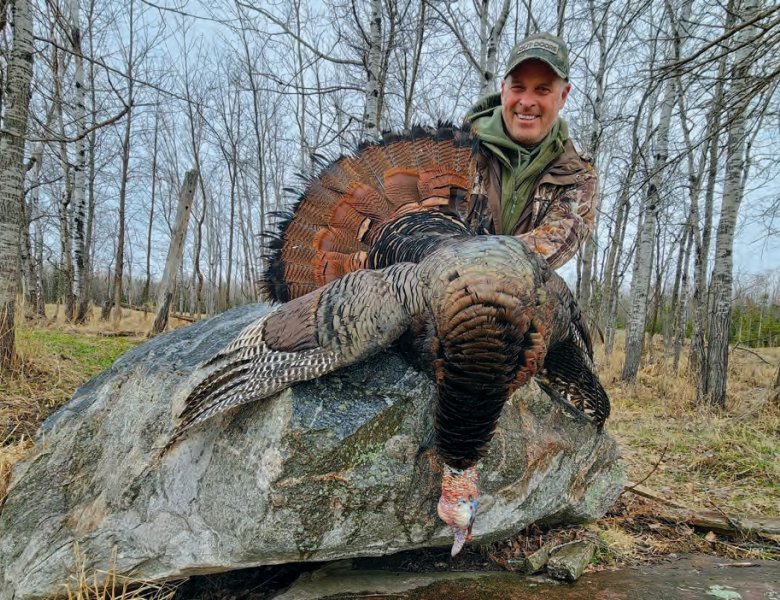
Immediately, the turkey stretched its neck and turned its head – just the moment I’d been waiting for to pull the trigger! Suddenly stunned, the bird flapped its wings weakly two or three times before remaining completely inert. It was with a beating heart that I approached to admire the magnificent catch up close, with its long beard and the large separons on its legs. The old warrior had finally been lured by a mixed use of different decoys and thus drawn towards the caller and within range of my weapon. I was particularly proud of this!
Main types of call
What follows is a description of the concepts behind the main calls that turkey hunters can use, as well as tactics and the best times to use them.
The box-call
This type of call works on an ancient and simple principle, namely the rubbing of a rotating piece of wood against the upper edges of a small hollow box also made of wood. The sounds produced in this way can create an incredible variety of realistic imitations of turkey calls, and they also tend to produce greater resonance than other types of call available. Box calls can be made from a variety of wood species, but cedar is a traditional wood, producing a good quality tone (also used in the construction of some acoustic guitars).
As this type of call requires less effort to learn in order to obtain a realistic sound, it is the one chosen by most beginners. It’s all about establishing a good rhythm of short, gentle rubbing movements of the rotating piece of wood to duplicate the yelps of a wild turkey. Once this type of call has been performed well (you can double-check the realism of your calls by consulting several video sequences on the Internet), you can move on to learning to imitate clucks. These two calls are relatively easy to perform on a box caller, and at the same time represent the most common vocalizations in the turkey’s vocabulary.
Over the years, various shapes and sizes of box calls have been developed, with some models incorporating a variety of features, such as removable and replaceable lid tabs with different coverings and producing different sounds. However, it’s not just the ease-of-use aspect that makes the box call desirable, as it also produces a sound and tone of great authenticity. When a male turkey doesn’t seem to want to respond to calls made by other types of call, the can call is often successful in eliciting a response.
Under certain conditions, this type of call is sometimes the only viable option, for example on windy or rainy days when turkeys’ hearing ability may be impaired. That’s when the loud sound of a box call can capture the attention of a distant bird. Hunting inside a hide tent is another situation where a box call can be used, thanks to the high sound capacity of this model and the fact that the movements involved in using this type of call are less likely to be perceived by the game. Some box calls have even been produced with a protective waterproof coating on the lid flap and box rim, to avoid the possibility of the call becoming “voiceless” in wet weather.
The slate call
Called a slate call (because of its traditional slate friction surface) or pot call (because of its small, pot-shaped resonance box), this model is another popular and effective type of call. It comprises three main parts: the friction surface (slate, glass, aluminum, copper or other) nested on a compact, rounded resonance box, and a stick for manually applying friction to the surface. The rounded resonance box also offers an ergonomic grip.
Some models of this type can feature different friction surfaces to produce distinctive yelping, clucking and cooing (purr) sounds. However, in rainy conditions, the slate friction surface may not be able to make effective sounds, which is why some models with different friction surfaces are available. Strikers, meanwhile, are available in a variety of styles and lengths, and made of different materials ranging from wood to plastic or Plexiglas, each producing a particular type of sound.
This type of call normally requires some sort of conditioning before use, which is often overlooked by novice users and can easily become a frustration. Conditioning is just a fancy term for a small operation to roughen the friction surface, which is usually done with fine-grade sanding paper (#200), chalk or a special pad. By grinding in one direction and scratching the end of the stick in the opposite direction, the friction causes sounds that can imitate clucking, yelping and cooing in a soft, subtle way, typical of this type of bird call.
Do not use a circular motion of the stick on the friction surface, but small scraping movements in one direction only. If the end of the stick becomes dirty or rubbery, it is likely that the stick will not be able to produce quality sounds, and fine-grained sandpaper should be used to clean and roughen it.
Compared with a box call, the slate call is a little more complex, and generally requires more repetition to achieve the desired effect. Hold the stick a little like a pencil, with your index finger about 1″ (2.5 cm) from the tip. Then bend the stick forward at a 45-degree angle to make contact with the slate, keeping the angle and pressure constant as you rub. You may also need to determine the best point of contact on the slate to achieve the most desirable sound, as different friction surfaces have their own peculiarities in this respect.
Mouthpieces
Although it’s generally more difficult to master the proper use of a mouth call, in use this type of call has gained great popularity and earned a good reputation for efficiency and practicality among avid turkey hunters. Also known as diaphragm calls, these consist of a simple horseshoe-shaped plastic or thin metal support inside which is stretched one (or more) latex lamella(s). This call is placed against the roof of the mouth and, with the aid of a certain amount of tongue pressure on the diaphragm, the exhalation of air produces vibrations that can imitate all the main types of wild turkey call.
It’s the trickle of air passing over the membranes that results in vibrations similar to those of air passing over human vocal cords. These vibrations, accompanied by different pressures from the tongue, produce both the volume and the tone of the call. Calls with a single, thin membrane produce clearer sounds, like those of a young bird, while those with multiple membranes result in a slightly deeper sound, like that of a more mature bird. The membranes often feature a slit or notch that adds an extra dimension of sound to the calls.
FEW HUNTING EXPERIENCES ARE MORE SATISFYING THAN LURING A MATURE MALE TURKEY WITH CALLS HE CAN’T RESIST!
The mouth call is not for everyone, and its use presents a greater learning curve for novice turkey hunters. However, when you need to free up your hands to produce subtle, inviting calls to male turkeys at close range, this type of call is the best solution.
There is a huge variety of mouthpieces on the market, each with its own distinctive tone. When it comes to use, the most important thing is practice, because the more comfortable you are at extracting the most desirable sounds in good time, the more effective your calls will be. When a large, hesitant tom remains just out of range of your gun, the well-controlled emission of soft, inviting cackles from a mouth call can easily be the convincing element that brings the confrontation to a successful conclusion!
In conclusion
When it comes to wild turkey calling efficiency, techniques present a wide variation of possibilities, and some of this efficiency can only come about as a result of some experience in the field. However, by becoming more familiar with and eventually mastering the three types of calls described, you’ll be well on your way to success in a variety of hunting situations. And few hunting experiences are more satisfying than luring a mature male turkey with calls he can’t resist!
